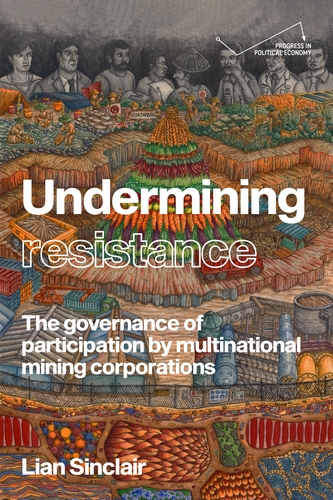
Please join our upcoming workshop on Lian Sinclair’s recent book about the ‘governance of participation by multinational mining corporations’
When: Thursday, 26 November 2026 at 10am CET / 9am UK time
Where: On zoom, register here: https://bham-ac-uk.zoom.us/meeting/register/n6TwuRrvQA6PZ3xG6JDhhQ
Speaker:
Dr. Lian Sinclair is postdoctoral research fellow in Geography at the University of Sydney’s School of Geosciences, where they have published widely on critical mineral global production networks. Their current research has shifted towards regional energy transitions and infrastructure. Lian is also an Honorary Research Fellow at the Indo-Pacific Research Centre, Murdoch University, where they completed their PhD in 2020. Adjacent to academia, Lian is chairperson of the Mineral Policy Institute, a civil society think tank facilitating dialogue across climate, environment, First Nations and workers’ organisations about the role of mining in a just energy transition.
Discussant:
Dr. Angela Wigger, Associate Professor of International Relations, Radboud University Nijmegen
Find the book here: https://manchesteruniversitypress.co.uk/9781526173331/
Abstract:
Since the 2000s, the governance of extractive industries has been relegated to the realm private governance or ‘soft-law’ as corporate self-regulation through a network of international associations, standards and principles, while corporate participation mechanisms devolved to local scale. My recent book Undermining Resistance (Manchester University Press, 2024) sets out a critical political economy of ‘Extractive accumulation’ – the collection of strategies and relationships across local, national and global scales that enable corporations to secure access to natural resources and profit from their extraction within capitalist economies. Chapter 2 traces how multinational corporations set up extensive private governance networks while localising participation in response to sustained resistance by people most affected by extractive operations. Now, the current boom in ‘energy transition minerals’ used in global production networks of renewable energy infrastructure and electric vehicles, has seen the emergence of new contestations. Nevertheless, states like Australia continue to refuse to upgrade environmental protection legislation, Aboriginal Heritage protections or regional planning mechanisms. Will a proliferation of new conflicts jeopardise the legitimacy of the energy transition, more broadly? Or, are there new quasi-legal mechanisms emerging that can undermine resistance to ‘green-extractivism’?

